Wednesday, March 29, 2017

Matilda Joslyn Gage - Wednesday's Woman of the Week!

After a brief hiatus due to the very hectic budget season we our back with Wednesday's Woman of the Week! This week we are highlighting the suffragist and Native American activist, Matilda Joslyn Gage.

Image result

Gage was a native New Yorker born in Cicero, NY. After settling in Fayettville, NY she made her home a stop on the Underground Railroad. Gage was an abolitionist who faced prison for her actions under the Fugitive Slave Law of 1850 which criminalized assistance to escaped slaves. Even though she was beset by both financial and physical (cardiac) problems throughout her life, her work for women's rights was extensive, practical, and often brilliantly executed.


 Image result for matilda joslyn gage

Although Gage was able to speak at the first Women's Rights Convention in Seneca Falls she went on to address the third National Convention in Syracuse. Later in life Gage focused her attention on the brutal and unfair treatment of Native Americans. 

Gage was a major playing in both the suffrage and abolition movements. Her home remains as a historical site in Fayettville where visitors can tour the home and even sit on her antique furniture. To learn more visit: http://www.matildajoslyngage.org/  

Wednesday, March 8, 2017

Happy International Women's Day!

Today we celebrate women from all over the globe for their perseverance, dedication, and achievements. Without the women who came before us we would not enjoy the rights and freedoms that we hold so near and dear.

Today we would like to highlight a woman that played a very direct role on the League, First Lady Eleanor Roosevelt. Most people know Eleanor for her work as a humanitarian and activist but many are unaware that Mrs. Roosevelt was also an active League of Women Voters member. She believed that the League enabled people to become informed citizens. The League also helped many women become involved in politics at the local and even national level.

Image result for eleanor roosevelt
Deeply involved in social justice work, Eleanor Roosevelt believed strongly that women deserved a place at the table when it came to politics. Prior to her husband’s presidency, she worked with and helped lead a number of women’s groups, including the International Congress of Working Women, the Woman's Trade Union League and the Women's International League of Peace and Freedom. After the League of Women Voters was founded in 1920 – the same year that Franklin D. Roosevelt ran for Vice President – she helped establish its policy agenda. As the League’s Vice President of Legislative Affairs, she lobbied for reforms in Congress and worked tirelessly to strengthen women’s role in politics, helping mobilize women voters through the League’s nonpartisan training and lobbying work. “I’ve always found that the best workers in a political party frequently are graduates of the League of Women Voters,” she wrote in 1953. “Members learn how to find out what they really want to know on a wide variety of subjects. The League…trains good citizens who have a sense of responsibility about what goes on in their locality, in their state and in their nation.” Even after she resigned as League Vice President in 1924, she remained an active League member and continued to promote the League’s platforms and ideals, including regularly writing for the League of Women Voters of New York’s newsletter.


Eleanor Roosevelt’s work to empower women’s participation as voters and political leaders only strengthened after her husband assumed the presidency in 1933. She consistently campaigned for the Roosevelt administration to hire women for executive level appointments, supported anti-lynching campaigns and fought for fair housing for minorities. Throughout these efforts, she held press conferences to inform women voters, including urging them to speak their minds and engage on policy issues.

Today we give thanks for all the Eleanor Roosevelt did for the League.

You can read more about Eleanor Roosevelt on the National League of Women Voters Website here.
Wednesday, March 1, 2017

Happy Women's History Month!

Today the League joined Lieutenant Governor Kathy Hochul, the Legislative Women's Caucus, and the Suffrage Celebration Commission to kick off Women's History Month! Our President, Dare Thompson, is a member of the New York Suffrage Commission and we are so excited to be a part of the state's celebration.


Tomorrow we will be joining our Albany County League at Huxley Theater in Albany to watch "Petticoats of Steel", a Capital Rep production and recreation of the events surrounding women winning the right to vote.


The Lieutenant Governor's office will be launching a website ny.gov/suffrage to collect information on women's suffrage celebrations in New York State. The League has already created a calendar of events put on by our local Leagues all over New York State which can be accessed here. Be sure to check back on the calendar as we are updating it almost daily!

We are so excited to move forward with the Commission and can't wait to see what new events will be on the horizon! 

Wednesday, February 22, 2017

Frances Ellen Watkins Harper - Wednesday's Woman of The Week!

Frances Ellen Watkins Harper, was and African American lecturer, author, poet, and suffragist. Her antislavery verse, Poems on Miscellaneous Subjects (1854), sold thousands of copies and  “The Two Offers”(1859) was the first short story published by an African American. Touring Southern Freedmen’s communities, she lectured on education and morality as racial uplift, and denounced white racial violence. Her suffrage work was long-standing. In the split among suffragists over the 15th Amendment, Harper favored voting rights for Black men; she affiliated with the American Woman Suffrage Association, and delivered speeches at its conventions.

Image result for Frances Ellen Watkins Harper

Born in Baltimore of free Black parents, she was orphaned before she was 3. Reared by an uncle, whose school for free Blacks she attended, Harper was first a teacher, then a lecturer for the Maine Anti-Slavery Society. She married Fenton Harper in 1860, but was widowed within 4 years and returned to lecturing. Her Southern travels resulted in several narrative poems. She became head of the African American department of the Woman’s Christian Temperance Union. She helped organize the National Association. of Colored Women’s Clubs and became vice-president. She died in Philadelphia at 85.


Learn more about Frances Ellen Watkins Harper at the National Women's History Museum.

Wednesday, February 15, 2017

Nannie Helen Burroughs - Wednesday's Woman of the Week!

Nannie Helen Burroughs, founded the National Training School for Women and Girls in Washington, D. C. in 1909. The school served as a national model school for the teaching of African American women. Burroughs believed that education, job training, and voting rights were the tools for Black women’s empowerment. In 1915 she wrote an article in the Crisis, in the official magazine of the NAACP, demanding the ballot as a protection for African American women and the route to racial advancement.

Burroughs
Nannie Helen Burroughs, Library of Congress Prints and Photographs Division (LC-USZ62-79903)

Before founding the National Training School for Women and Girls, Burroughs  graduated from high school with honors in 1896.  She worked in Louisville for the Foreign Mission Board of the National Baptist Convention.  Burroughs formed women’s industrial clubs throughout the South teaching night classes in typing, stenography, bookkeeping, millinery, and home economics to Black women. Through her powerful oratory she became secretary of the National Baptist Woman’s Convention and, building on her teaching experience and grassroots network among Baptist women,. Under the motto, “We Specialize in the Wholly Impossible,” her school blended industrial training and the liberal arts with a Christian education. She maintained her own publishing house, trained women missionaries, and educated African American women to be self-sufficient wage earners. She was a power player among both Black and white women.  She died in Washington in 1961; her school continues today.

Read more on Nannie Helen Burroughs at the National Women's History Museum Website


Wednesday, February 8, 2017

Mary Eliza Church Terrell - Wednesday's Woman of the Week!

Mary Eliza Church Terrell was an African American suffragist who fought not only for women's voting rights but also for United States citizenship for African Americans. Terrell was active all over the country and lectured on the importance of African American women voting. She felt voting was essential for African Americans to gain equality.

Terrell
Mary Eliza Church Terrell, Library of Congress Prints and Photographs Division (LC-USZ62-54722)
Later Terrell would go on to become president of the National Association of Colored Women. She campaigned tirelessly among black organizations and mainstream white organizations for black women’s suffrage. She even picketed the Wilson White House with members of the National Woman’s Party in her zeal for woman suffrage. 


Following the passage of the nineteenth amendment, Terrell turned her attention to civil rights. In 1948, Terrell became the first black member of the National Association of University Women. In 1950 she worked to desegregate the John R. Thompson Restaurant in Washington, D.C. and her effort came to fruition with a 1953 Supreme Court decision banning discrimination in public places in the District of Columbia. Terrell fought for woman suffrage and civil rights because she realized that she belonged “to the only group in this country that has two such huge obstacles to surmount…both sex and race.” She lectured, organized, and battled to better the lives of African American women throughout her life.

For more on Mary Eliza Church Terrell visit The National Women's History Museum

Wednesday, February 1, 2017

Sojourner Truth - Wednesday's Woman of the Week!

February is Black History Month; what a fantastic opportunity for the League to highlight some truly revolutionary African American Suffragists!

Truth
Sojourner Truth, Library of Congress Prints and Photographs Division (LC-USZ62-119343)

Although white women were able to vote freely after 1920, most African American women still faced great adversity when they tried to cast their ballot at the polls. These women were often intimidated by poll workers, threatened by other voters, and sometimes even viciously attacked. African American women fought side by side with white women for the right to vote and for equality among men.

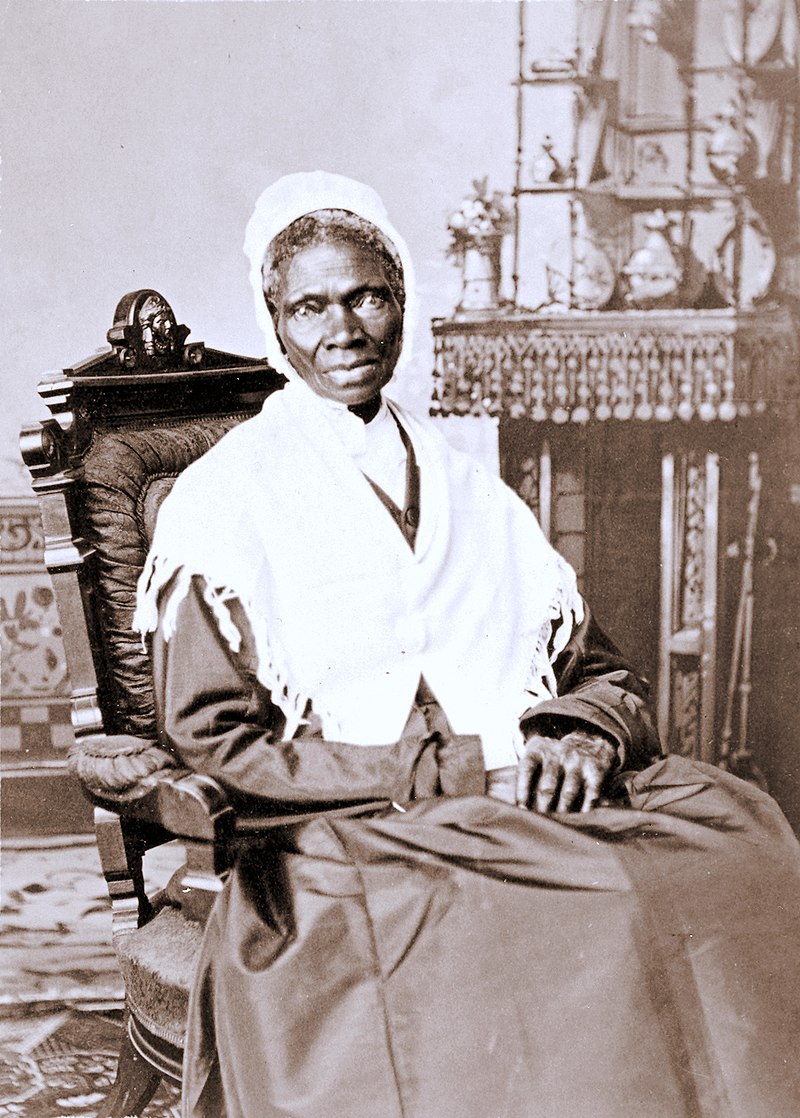
Today we highlight Sojourner Truth. Truth was an activist and preacher.  Truth was born into slavery in Swartekill, Ulster County, New York, but escaped with her infant daughter to freedom in 1826. Before she fought for the right to vote she was extremely active in the abolition movement. After the Civil War Sojourner fought to see that African American men who served in the war were awarded land in the west. 
Sojourner truth c1870.jpg
An albumen silver print from approximately 1870 by Randall Studios
Truth is best known for her speech she delivered in 1815 at the Ohio Women's Rights Convention in Akron, Ohio. The speech became widely known during the Civil War by the title "Ain't I a Woman?"

For more on Sojourner Truth visit The National Women's History Museum here.